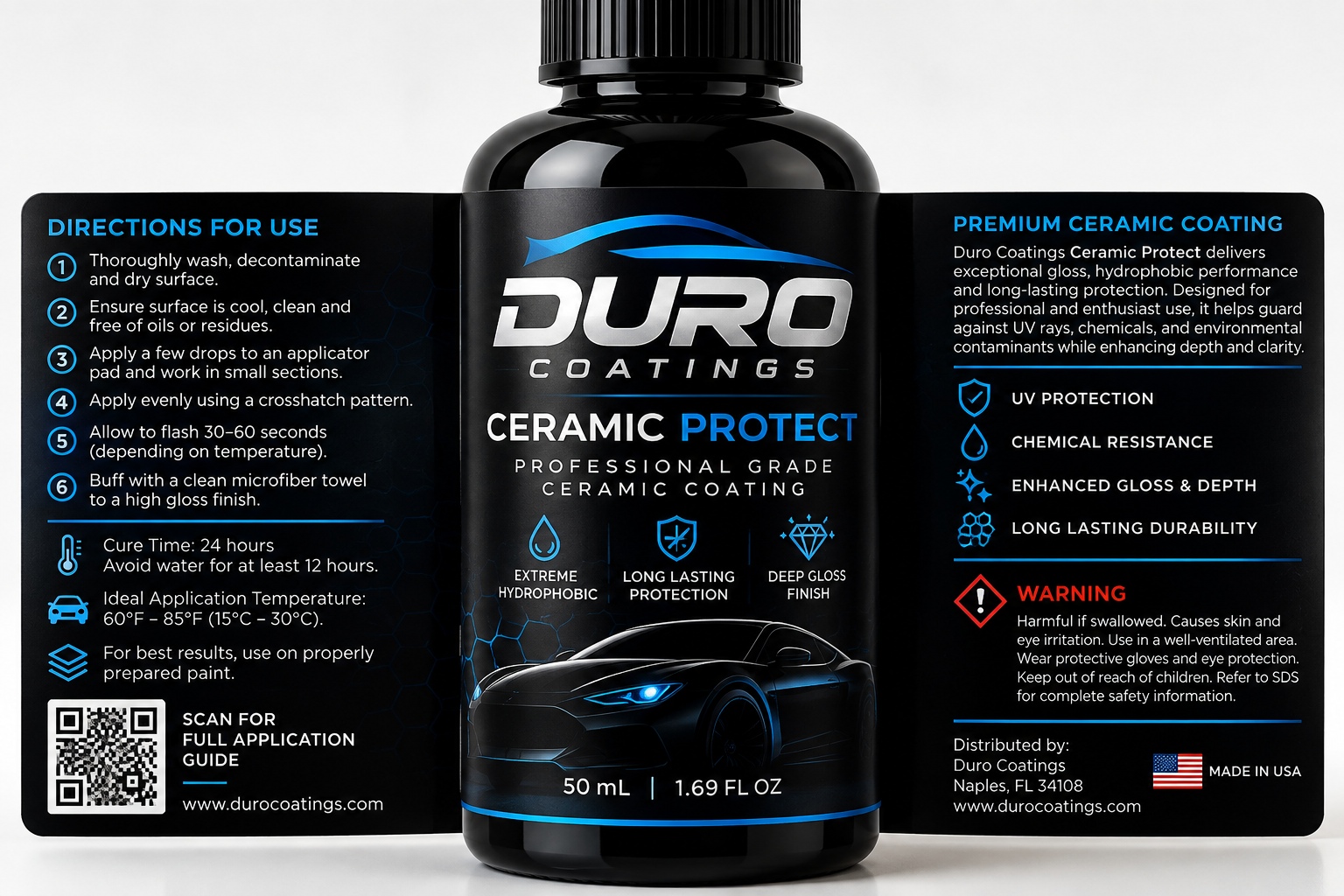
What an automotive ceramic coating is
Automotive ceramic coating is a liquid surface-treatment product that forms a thin film as it dries and cures. In consumer and professional marketing, “ceramic” commonly refers to coatings using silicon-containing chemistry, including silica (silicon dioxide, written SiO₂) or silane-derived ingredients. Formulas may also use organic resins, solvents, additives, or other materials. The word on the label alone does not tell you the complete composition, thickness, performance, or service life.
A coating is not a new factory clear coat, a repaint, or a thick armor layer. On painted panels it is applied over the vehicle’s existing finish, usually the clearcoat, so the paint beneath remains responsible for color and much of the system’s physical protection. A well-finished surface can look deeper or more reflective after application, but a car ceramic coating does not repair missing paint, deep scratches, chips, or clearcoat failure.
“Ceramic” is also not a regulated promise that every product has the same hardness or protective capability. Some products are intended for trained professionals; others are sold for consumer application. Compare each product’s technical documentation, safety information, approved surfaces, and maintenance instructions instead of assuming two bottles with similar terminology behave alike.
How ceramic coating works
At a useful, non-formula-specific level, the liquid is spread over a clean surface and then loses carrier ingredients while the coating’s film-forming components set. Depending on the formulation, surface chemistry, and conditions, the film may attach through a combination of chemical interactions, cross-linking, and physical adhesion. The exact mechanism cannot be inferred from the words “SiO₂ coating,” and a general explanation is not a substitute for a product’s technical sheet.
Silicon dioxide is a material used in many kinds of coatings, glass, and ceramics. Some coating systems use silanes, molecules that can help connect inorganic and organic parts of a coating network. Research on silica-and-silane composite coatings demonstrates how those ingredients can be combined, but a study on glass does not prove how an automotive product bonds to clearcoat. Nor does it establish the ingredients or performance of any particular brand.
On a vehicle, the practical goal is a continuous film over a sound, prepared finish. Oils, polishing residue, old protection, moisture, dust, or incompatible materials can interfere. The correct cleaner, panel-prep method, amount, leveling, and waiting periods remain product-specific.
What a coating can—and cannot—protect
Many owners notice that washing releases grime more readily. Depending on the product and its condition, a coating may also improve gloss or resist some contaminants better than untreated paint. These benefits do not guarantee that every contaminant will rinse away or that paint cannot be damaged.
Chemical resistance depends on test conditions. Bird droppings, bug residue, sap, road film, and mineral deposits can still mark coated paint, especially when left in heat. Compare claims by test method, concentration, exposure time, substrate, and care conditions; “chemical proof” is not meaningful evidence.
A thin liquid film is not scratch- or chip-proof and does not replace physical impact film. Abrasive washing, grit, keys, road debris, polishing, and collision can still damage the paint or coating. For impact resistance, compare paint protection film.
UV and environmental performance needs product-level test evidence. Do not assume a coating blocks meaningful UV or prevents oxidation indefinitely; shade, washing, prompt contaminant removal, and paint condition still matter.
- Reasonable expectation: easier routine washing and a changed water response, when the film is properly applied and maintained.
- Not a reasonable expectation: immunity to scratches, stone chips, water spots, all chemicals, or neglect.
- Evidence to request: a defined test method and conditions for any claim that matters to your decision.
Hydrophobicity, gloss, and the limits of beading
Hydrophobic describes a surface’s tendency to repel water. On some coated surfaces, water forms rounded beads; on others it sheets or moves away. The pattern depends on the coating, contamination, maintenance products, panel angle, water, and environmental conditions. Water behavior can be satisfying to watch, but beading by itself is not a complete measurement of protection, film integrity, or remaining service life.
Gloss comes from how the underlying paint and surface reflect light. Cleaning and polishing can remove a film of contamination and refine defects that scatter light; a coating can then change the surface’s appearance. The coating does not fill or permanently hide every defect, and its shine cannot be separated from the condition of the paint beneath it. Inspect in more than one lighting condition before deciding whether correction is appropriate.
A highly water-repellent surface is not necessarily self-cleaning. Droplets can carry some loose dirt as they move, but they can also evaporate and leave minerals behind. Hydrophobicity should be treated as a surface behavior that may make washing easier—not as a promise that a vehicle can stay clean without washing.
Ceramic coating vs. wax vs. paint sealant
These categories overlap in everyday language, and products within each category vary. Traditional waxes may contain natural waxes; modern “wax” products can also be blends. Paint sealants generally rely on synthetic film-forming chemistry. Ceramic coatings are marketed as a cured, longer-wearing surface film, often with silicon-containing ingredients. No category label guarantees a specific durability, gloss, or chemical-resistance result.
Choose by use and instructions rather than by a simple ranking. A wax or spray sealant can be a sensible fit for someone who enjoys frequent reapplication or wants a short-commitment product. A coating may suit an owner seeking a more persistent layer and willing to invest in careful preparation, application, and ongoing washing. Product-specific evidence is more useful than a universal month or year comparison.
| Option | What it generally means | Potential fit | What to verify |
|---|---|---|---|
| Wax | A topical product whose ingredients and film behavior vary by formula. | Short-term appearance and a hands-on care routine. | Application compatibility, reapplication guidance, and weather limits. |
| Paint sealant | A broad term for products designed to leave a protective surface film. | An owner who wants a straightforward, repeatable maintenance product. | Actual test data, compatible cleaners, and expected upkeep. |
| Ceramic coating | A liquid coating that cures to a thin film; many products use silica- or silane-related chemistry. | An owner or shop prepared to follow detailed prep, application, and care instructions. | Approved surfaces, safety sheet, cure conditions, performance evidence, and warranty terms. |
Ceramic coating vs. paint protection film
Paint protection film (PPF) is a physical film installed over selected painted panels. Its thickness and construction are intended to provide a different kind of protection from a liquid coating, including help against certain road impacts and paint chips. Results depend on the particular film, the installation, panel coverage, and its care requirements.
A ceramic coating is much thinner and is not a substitute for an impact-rated film. Owners commonly consider PPF for high-impact areas and may consider an additional coating for appearance or maintenance, but compatibility and installation order must be confirmed by the manufacturers of both products. Some films have their own surface finish or care rules. Do not assume a coating can be applied over every film.
There is no universal winner. If stone chips are the main concern, evaluate film coverage. If routine cleaning and surface behavior are the priority, evaluate coating documentation. If both matter, ask the installer to explain the exact film and coating combination, which surfaces receive each, and what each warranty actually covers.
| Question | Ceramic coating | Paint protection film |
|---|---|---|
| Main role | A thin cured surface film; often chosen for water behavior, cleaning, and appearance. | A physical film used for selected areas where impact protection is important. |
| Stone chips | Not a substitute for film designed to help protect against chips. | A primary use of automotive PPF, subject to the specific film and coverage. |
| Fit decision | Check formulation, approved surfaces, prep, application, and maintenance. | Check film coverage, edge placement, appearance, care, and installation quality. |
DIY vs. professional ceramic coating
DIY can be reasonable when a coating is explicitly sold for consumer use, the vehicle and workspace fit the instructions, and the person can follow the process patiently. The work usually requires a clean, well-lit area, time for preparation, careful application, and a plan to protect the vehicle during the stated cure period. Read the complete label and safety data sheet before opening the product.
Professional installation can be useful when paint needs assessment or correction, the vehicle has complex surfaces, the owner lacks a suitable workspace, or the chosen coating is restricted to trained installers. Experience and equipment do not guarantee a good result by themselves. Ask how the shop inspects paint, documents existing damage, manages application conditions, checks for missed or uneven areas, and explains aftercare.
Compare the actual scope before comparing prices. One quote may include decontamination and paint correction; another may not. Ask what surfaces are included, what correction level is planned, how defects will be treated, which coating product will be used, what the written warranty covers, and what follow-up maintenance is expected. Avoid paying for a named package until those details are clear.
Surface preparation and paint correction
Preparation starts with inspection, not with a polishing machine. The installer or owner should identify the surface material, paint condition, previous repairs, existing protection, contamination, and the result the owner expects. Freshly refinished panels may require a different process from factory paint; follow the relevant paint-system and coating-maker instructions rather than applying a generic wait time.
A safe general sequence is to remove loose soil with a thorough wash, inspect the clean paint, address bonded contamination only with suitable methods, and decide whether polishing is justified. Chemical decontamination and mechanical clay can both affect a finish when used incorrectly, so use appropriate products and technique. The goal is not to perform every possible step; it is to leave a clean, compatible surface without creating new defects.
Paint correction is controlled polishing intended to improve the appearance of some defects. It can remove a small amount of clearcoat, so it should be conservative. A test area helps determine whether the desired result can be reached safely. Deep scratches, chips, cracks, failing clearcoat, and defects that require excessive removal may need a body repair rather than more polishing. A coating preserves the result it is applied over; it does not repair an unsafe or failing finish.
Application, flash time, and curing
Application instructions are not interchangeable between brands or even between products from one brand. The label or technical sheet may define an approved substrate, working temperature, humidity range, application area, applicator, amount, leveling method, and number of layers. Those details govern. This article intentionally does not give a universal coating recipe or a DURO-specific procedure.
“Flash time” generally describes the product-specific working interval after spreading and before the material should be leveled or wiped. The visible cue, interval, and tolerance depend on chemistry and conditions such as temperature, humidity, airflow, panel temperature, and the amount applied. A window borrowed from another brand can lead to streaks, high spots, or difficult leveling.
Curing is the longer process in which the applied film continues to set and develop its properties. A product may specify separate periods for leveling, keeping the vehicle dry, avoiding washing, and reaching full service readiness. Do not confuse a short flash interval with full cure. If conditions change or a step is missed, consult the manufacturer rather than extending or shortening the process by guesswork.
- Read the product label and technical sheet before preparing the vehicle.
- Check panel and room conditions against the exact product limits.
- Use clean applicators and towels as directed; dispose of used materials according to the label.
- Keep the vehicle in the conditions specified during its initial cure.
Maintenance after coating
A coating does not remove the need to wash a vehicle. Dirt, road film, salt, minerals, and organic deposits still collect on the surface. Regular, careful washing removes contamination before it becomes difficult to remove, while harsh tools or a dirty wash mitt can scratch coated or uncoated paint alike.
Use the maintenance products and wash method approved for the exact coating. A pH-neutral shampoo is common advice, but a coating maker may specify particular cleaners or exclusions. Avoid assuming that an aggressive degreaser, abrasive polish, automatic brush wash, or unapproved topper is harmless. Follow vehicle-maker instructions as well, particularly for matte finishes, wraps, sensors, trim, and repaired panels.
Drying can reduce visible mineral residue, especially when water is hard or a vehicle sits in direct sun. If water spots or droppings appear, remove them promptly using a method suitable for the coating and paint. Do not attack a spot with a rough towel or compound before identifying whether it is residue on the surface or damage below it.
Hydrophobic behavior may change as the surface becomes dirty or contaminated. Wash and assess before concluding that the film has failed. Use a manufacturer-approved cleaning or inspection process, not a random “booster.” Keep service and maintenance records for later diagnosis.
Durability, warranty, and service life
There is no single service life for “ceramic coating.” Durability varies with formulation, surface preparation, application quality, exposure, washing, and maintenance. A product claim is only meaningful when you understand its test method or use conditions. A warranty is a separate promise whose scope depends on its written terms; a stated warranty duration does not, by itself, establish how long a coating will look or behave a certain way.
When comparing claims, ask what the period measures, what conditions qualify, whether registration or scheduled inspections are required, which maintenance products are allowed, and what remedy is offered. Separate measured performance, expected service life, and warranty coverage. They are related questions, but they are not interchangeable.
DURO’s current public product record lists DURO ONE and DURO PRO. DURO PRO is listed at $199 with a 10-year warranty duration; the warranty conditions and product-specific durability data have not been supplied for this page. That statement does not establish a 10-year coating service life, and it does not apply to DURO ONE.
Water spots and common coating problems
Evaporation can leave minerals or residue. Depending on water, exposure, and paint, spots may sit on the surface or affect the finish. Coatings do not stop every droplet drying; preventing deposits is easier than correcting etching later.
Uneven application can leave a visible high spot, streak, haze, or patch. Contamination, incompatible prep residue, excess material, conditions outside the product limits, or mistimed leveling can contribute. Diagnose against the product instructions before attempting repair.
Low beading can result from dirt, changed maintenance products, film wear, or misunderstood behavior. Wash and inspect consistently before acting. Avoid aggressive chemicals or abrasives; ask the manufacturer or a qualified paint professional if the remedy is unclear.
| What you notice | Possible explanation | A careful first step |
|---|---|---|
| Water no longer beads as before | Surface contamination, a changed maintenance product, or film wear. | Wash with an approved method and compare on a clean panel. |
| A visible streak or high spot | Uneven leveling, contamination, or a condition outside the product instructions. | Inspect in different light; ask the installer before polishing. |
| A pale ring after water dries | Mineral residue or a mark in the surface; severity varies. | Remove promptly with a coating-compatible method; do not scrub with abrasives. |
| A chip or deep scratch | Impact or mechanical damage to the paint system. | Treat it as paint damage; a thin coating is not chip repair. |
Frequently asked questions
Questions to consider
Does ceramic coating make a car scratch-proof?
No. A thin coating does not prevent scratches or stone chips and is not a substitute for impact film.
Does a ceramic coating stop water spots?
No. Water can leave mineral deposits when it dries. Prompt, coating-compatible care still matters.
Is ceramic coating always made from SiO₂?
No single label proves a complete formula. Many use silica- or silane-related ingredients; request product-specific documents.
Does every car need paint correction first?
Not always. Base preparation on paint condition, goals, and instructions. Polishing removes material, so keep it conservative.
How long does ceramic coating take to flash or cure?
There is no universal time. Follow the exact product label and technical sheet for flash, leveling, dry-time, and cure.
Can a coating be applied over PPF or a wrap?
Only if both makers approve the combination and application; surface and finish compatibility vary.
Does a 10-year warranty mean a coating lasts 10 years?
No. Warranty duration, coverage, test data, and service life differ; read the terms.
Can I use this general guide as DURO application instructions?
No. Use official DURO instructions and safety documents for product-specific surfaces and application.